September 17, 2026
Put Studio Conners in Motion
Can we establish Studio Conners’ social distribution presence and begin turning our existing Obsession history into a repeatable vertical-video practice?
What came of the day
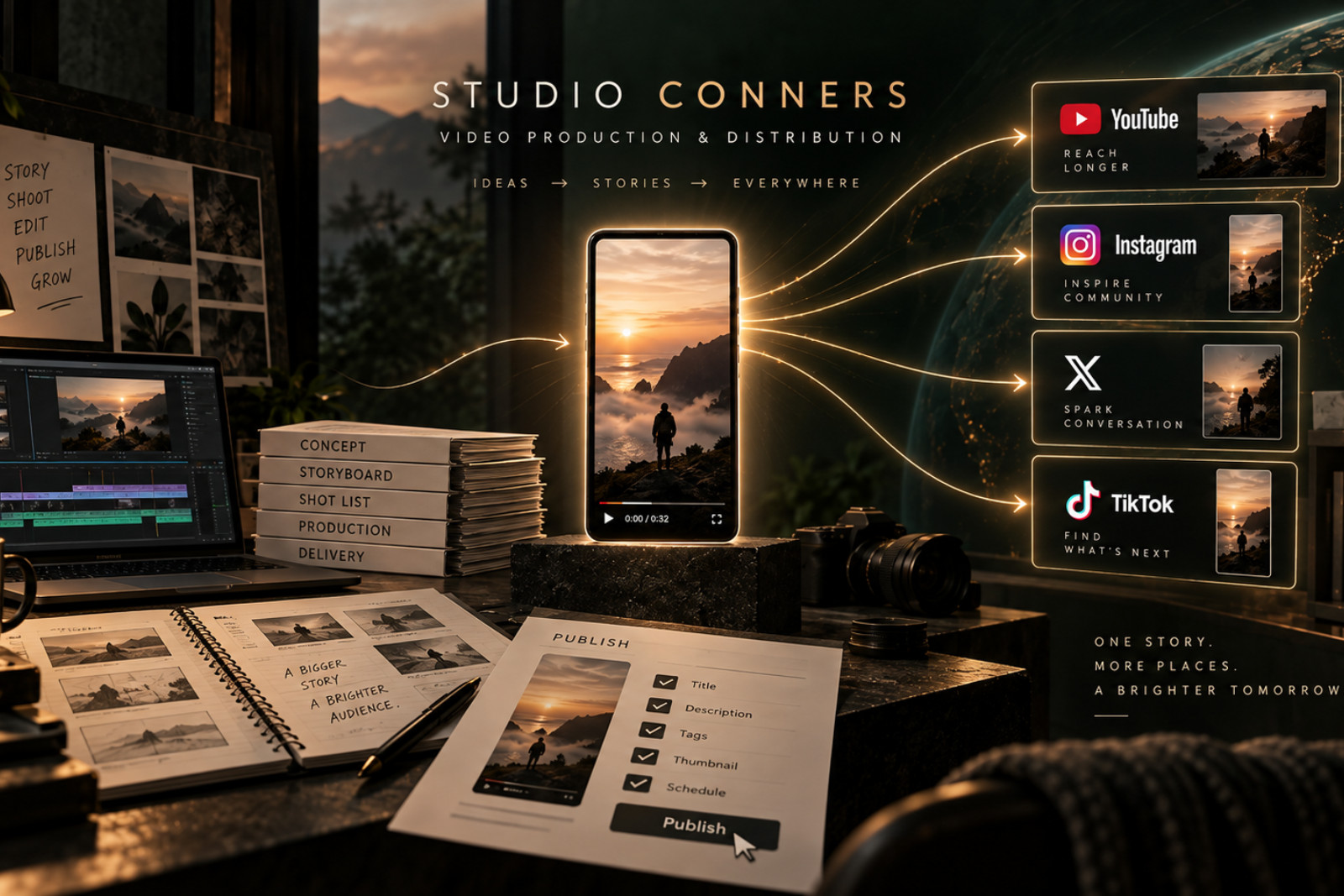
We proved the first complete Studio Conners work-to-distribution path using the August 30 ObsessOS Obsession, “Bring ObsessOS Personal v0.1 to life.” The historical Obsession became a finished public Studio Conners Work Entry, then a 36-second vertical video was designed, assembled, reviewed, exported, attached back to the Work Entry, and published as a YouTube Short. The published YouTube distribution record was then saved into Studio Conners, and the public work page was upgraded so published distribution links now appear as part of the work’s public record. The production system also became clearer through use. Platform-specific music created unnecessary friction, so the vertical-video standard was revised: future Production Packets will include an original-audio generation prompt, with the intended default becoming a silent archival master plus a finished master with original generated audio that can travel across platforms. This day therefore produced both the first proven end-to-end distribution example and a better production standard for every Studio Conners video that follows.
The story
The day started with a very practical goal: take the first historical Obsession in the Studio Conners archive and finish its entire outward-facing life. Not just publish the Work Entry, but prove that the work could move all the way through video production, distribution, and back into the Studio Conners record without leaving loose ends behind. The first test was the August 30 ObsessOS Obsession, “Bring ObsessOS Personal v0.1 to life.” Its public Studio Conners Work Entry was completed first. From there, the Obsession was translated into a 36-second vertical story about the moment ObsessOS crossed from being something under construction into something actually being lived with. The video used real and reconstructed interface moments, restrained motion, the original cover image, and a quiet Studio Conners end card. After several passes through CapCut, the finished 9:16 master was exported and reviewed as an actual rendered file rather than assumed correct from the timeline. Distribution immediately exposed an important weakness in the plan. YouTube made it possible to add music after upload, but Instagram, TikTok, and X all handled audio differently enough that a supposedly universal silent master still created platform-specific production work. That led to a better rule: future videos should carry their own original audio. The production standard was updated so every video script now includes an audio-generation prompt, with the intended output becoming both a silent archival master and a finished audiovisual master that can travel intact across platforms. The first Short was published to YouTube and its public URL was saved back into the Studio Conners Work Entry. That revealed one final missing piece: distribution existed in the back office, but a visitor to the public Work page could not see that the work had gone anywhere. The site was updated so published distribution now becomes part of the public provenance of a Work Entry while internal captions, drafts, asset notes, and unpublished channels remain private. By the end of the day, Studio Conners had more than its first finished vertical video. It had its first proven loop: an Obsession became a public Work Entry, the Work Entry produced a distribution artifact, the artifact was published, and the public record now points outward to where that work traveled. The process is still manual, but it is no longer hypothetical.
Discoveries
One real work item is enough to prove the whole distribution system
The fastest way to validate the Studio Conners publishing model was not to theorize about every historical Obsession. Completing one Work Entry all the way through public publication, video creation, social distribution, and back-linking exposed the real workflow and the real friction.
The vertical video should be treated as a distribution artifact, not the canonical record
The ObsessOS Exhibit and Studio Conners Work Entry remain the durable record of the work. The video exists to extract one strong idea from that work and help it travel farther. This keeps the public archive richer than any individual social post.
The silent master is still useful, but it should not be the only finished master
A silent archival master preserves flexibility, but relying on platform-native music creates extra work and inconsistent publishing flows. The better standard is to keep the silent master and also produce a finished master with original audio already baked in.
Original generated audio can remove platform-specific publishing friction
YouTube, Instagram, TikTok, and X handle music differently, and commercial-use rules vary. Generating original audio with clear commercial rights can turn one finished video into a genuinely reusable cross-platform asset instead of requiring a separate audio decision for every platform.
Audio should be designed at the script stage, not added as an afterthought
The Production Packet should specify the soundtrack alongside the visual story: mood, energy, instrumentation, timing, sync moments, ending behavior, and a generation prompt. Audio becomes part of the editorial concept rather than a last-minute publishing step.
Public distribution belongs in the public provenance of the work
Once a Work Entry has actually been distributed, that fact is part of its story. Showing published channel links on the public Work page makes Studio Conners feel like a living archive while still keeping draft captions, packaging notes, and other back-office distribution data private.
The production system should get easier every time it is used
The first historical video required many manual decisions, but those decisions are now becoming reusable standards: asset structure, timeline construction, keyframe behavior, audio generation, export settings, and distribution recording. Each completed video should reduce the amount of invention required for the next one.
Results
ObsessOS — First Completed Studio Conners Work Entry
The August 30 ObsessOS Obsession, “Bring ObsessOS Personal v0.1 to life,” was fully completed as a public Studio Conners Work Entry, including its public story, hero image, ObsessOS Exhibit link, and distribution asset.
studioconners.com/work/obsessos/bring-obsessos-personal-v0-1-to-lifeObsessOS Vertical Video 001
A finished 36-second, 9:16 vertical video was created from the historical Obsession using editorially reconstructed interface moments, the original cover image, restrained keyframe motion, and a Studio Conners end card. The rendered master was reviewed and approved before distribution.
Open the fileFirst Studio Conners YouTube Short
The ObsessOS vertical video was published publicly as the first completed Studio Conners Short.
www.youtube.com/shorts/eZhLi0plViAWork Entry Distribution Record
The YouTube publication was recorded back into the Studio Conners Work Entry as a published distribution channel, closing the loop between the canonical work record and the outward-facing social artifact.
Public Distribution Provenance on studioconners.com
The Studio Conners public Work Entry page was upgraded so published distribution links now appear on the public record. Only channel name, public URL, and publication state are exposed; internal captions, draft channels, asset overrides, and back-office notes remain private.
Studio Conners Vertical Video Production Standard v0.2
The production standard was revised after the first real distribution test. Future Production Packets now require an original-audio generation prompt, and the intended output becomes both a silent archival master and a finished audiovisual master suitable for cross-platform distribution.
Open the file
Open threads
- What should the reusable ComfyUI workflow for original Studio Conners video audio look like?
- How should the remaining historical Obsessions be translated into the right vertical-video species without making them all feel the same?
- When should Instagram, TikTok, and X become part of the standard distribution path alongside YouTube Shorts?
- How much of the Work Entry → video → distribution → public provenance loop should eventually be automated without removing the editorial decisions we want to make ourselves?
- How should we balance processing the historical Obsession backlog with distributing each new Studio Conners work item on the day it is completed?