September 6, 2026
Make LOOK AT THIS CARD Real
Can we turn lookatthiscard.com into something my friends and I actually want to use?
What came of the day
We took LOOK AT THIS CARD from an early concept all the way to a live, usable product. During the day, we defined and refined the core experience, interaction model, visual direction, and product language, then carried those decisions into the actual build. We published the latest version of the site and invited the first two users, making September 6 the day LOOK AT THIS CARD moved from idea and prototype into a real product being used by real people.
The story
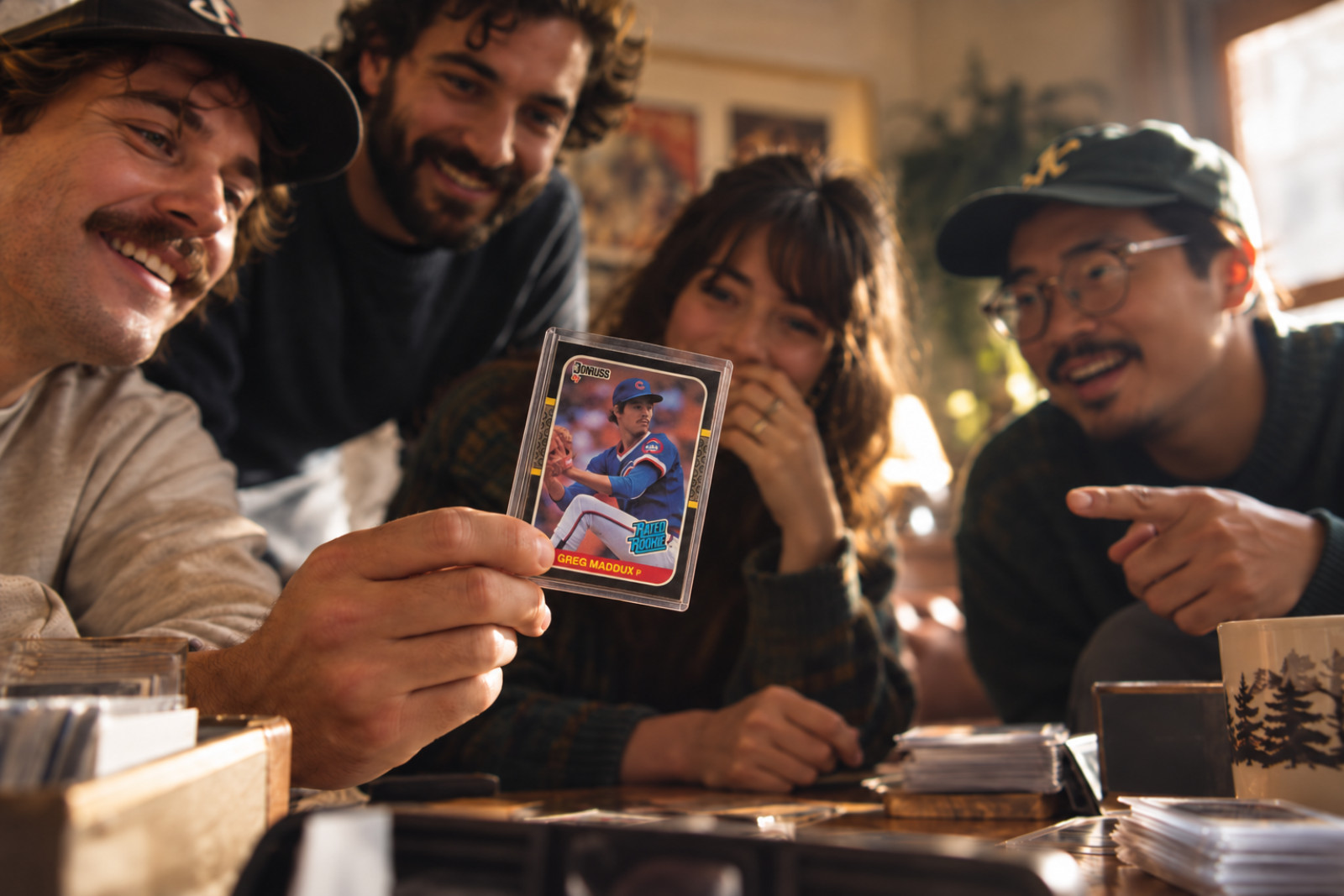
We started the day with LOOK AT THIS CARD as an idea that had been sitting around for a while: a place where a few friends could post funny, strange, or interesting sports cards, say something about them, and talk about what they saw. The basic idea was easy to understand. The harder question was what kind of product it actually wanted to be. As we worked through it, the Card itself became the center of everything. A Card would not just be an image attached to somebody's social-media post. It would be the object people gathered around. That led us to separate card fronts from card backs. A front naturally asks, “WHAT'S THE STORY?” and invites invented explanations, jokes, dialogue, memories, and riffs. A back encourages a different behavior: noticing some strange statistic, bit of text, or tiny detail and saying, essentially, “Hmm.” From there, the rest of the product began to organize itself. GOOD ONE became a small piece of applause for the Card rather than a scoring system. Stories and Hmms would not compete for likes or rankings. The gallery became a simple chronological collection of cards, with compact facepiles showing the people who had actually gathered around each one. One of the most interesting turns came when we thought seriously about invitations and moderation. What began as a simple invite-only signup system became an invitation tree. If every member enters through another member, that lineage can remain part of the community permanently. And once that structure exists, moderation can follow it. People can take responsibility for the community that grew beneath them, higher ancestors can correct decisions made below them, and the root retains final authority. Instead of bolting a conventional moderator bureaucracy onto a small social site, the community can largely govern itself through the same human relationships that caused it to grow. We kept refining the visual experience along the way, repeatedly removing things that made LOOK AT THIS CARD feel too much like ordinary social media. The cards became larger and more important. The interface became quieter. Familiar elements were kept only where they helped—like a thumbs-up for GOOD ONE—while the distinctive parts of the product were allowed to develop their own vocabulary and behavior. And then we built it. By the end of the Obsession, LOOK AT THIS CARD was no longer a domain name, a group idea, or even merely a prototype. The latest build was published, and the first two people were invited into the community. September 6 became the day we figured out what LOOK AT THIS CARD was—and then put it into the world.
Discoveries
The Card should be the social object, not the post author.
The product became much clearer once we stopped thinking of LOOK AT THIS CARD as people making conventional social-media posts and instead treated each Card as the thing everyone gathers around.
Fronts and backs naturally invite different kinds of participation.
A card front tends to provoke storytelling, jokes, imagined dialogue, and explanations—hence WHAT’S THE STORY? A card back tends to provoke noticing strange stats, text, facts, and details—hence Hmm. That distinction gives the product a natural interaction model rather than an arbitrary feature set.
The invitation tree can be the backbone of the community, not merely a signup mechanism.
Preserving who invited whom creates provenance and gives the community an understandable human structure as it grows.
That same invitation tree gives us an unusually simple moderation model.
Instead of inventing moderators, roles, committees, strikes, or complicated permissions, people can be responsible for the branch of the community that grew beneath them. An inviter can moderate descendants; higher ancestors can overturn decisions below them; and the root has final authority. Moderation therefore follows actual human relationships already present in the product.
Moderation should be reversible and accountable rather than destructive.
Hiding problematic Cards, Stories, or Hmms is enough. We do not need moderation to physically erase contributions. Keeping an immutable history of hides and restores gives us accountability while allowing higher ancestors to correct mistakes.
Different kinds of participation should carry different social weight.
Writing a Story or Hmm means someone actually joined the activity around the Card. GOOD ONE is lightweight appreciation. That distinction led us to exclude GOOD ONE-only reactors from the gallery facepile.
The facepile is not just decoration.
It became a compact way of showing, from the gallery itself, that a Card has attracted people and conversation. It communicates community activity without resorting to prominent scores, comment counts, or engagement statistics.
GOOD ONE works better as applause than as status.
Cards can receive a simple positive reaction, but Stories and Hmms do not need likes, rankings, upvotes, or scoring. That keeps attention on what people contributed rather than on who “won.”
The product gets stronger as we remove conventional social-media machinery.
No downvotes, no ranked comments, no algorithmic-looking feed, no elaborate moderation bureaucracy, and very little engagement chrome. A chronological gallery, the Cards, and the people gathered around them are enough.
The small, invite-driven nature of LOOK AT THIS CARD is a feature, not merely a launch constraint.
The invitation lineage, descendant responsibility, and absence of public signup all reinforce the feeling that this is a community grown through people who actually know one another.
Launching changes what we need to learn next.
Now that the site is live and the first two users have been invited, the important discoveries can start coming from real behavior: what Cards people choose to post, whether Story and Hmm feel natural without explanation, how invitation branches actually grow, and whether the social dynamic we designed emerges in practice.
Results
LOOK AT THIS CARD — Live v0.1
Built and published the first live version of LOOK AT THIS CARD: a public-browse, invite-only social experience for sharing collectible Cards and gathering Stories, Hmms, GOOD ONEs, and people around them. The finished build is live on the permanent custom domain.
lookatthiscard.com/Invitation Tree + Descendant Moderation
Built the permanent invitation-lineage system that records who invited whom and uses that same human tree for community moderation. Members can moderate descendants in their branch, higher ancestors can override lower decisions, the root has final authority, and moderation uses reversible hiding with an immutable audit history.
Author Remove + Restore System
Built a separate ownership system allowing people to remove and later restore their own Cards, Stories, and Hmms without deleting them. Author removal is enforced server-side, remains separate from moderation authority, preserves associated content, and includes a private Removed Items experience.
Finished Mobile + Posting Experience
Completed the responsive member experience, including the mobile multicolor-plus and hamburger navigation, direct phone camera or photo-library Card posting, polished desktop image selection and drag-and-drop, Card previews, profile-photo controls, and account password management.
First Users Invited
Invited the first two people into the finished production site, moving LOOK AT THIS CARD beyond a private build and beginning the real invitation tree and community.
Open threads
- What do the first real users actually do?
- Does the invitation-tree moderation model work socially?
- How quickly should the invitation tree grow?
- Where are the boundaries of “Card”?
- Does Front = Story / Back = Hmm hold up in practice?
- How much explanation does a new member need?
- Social sharing / link previews