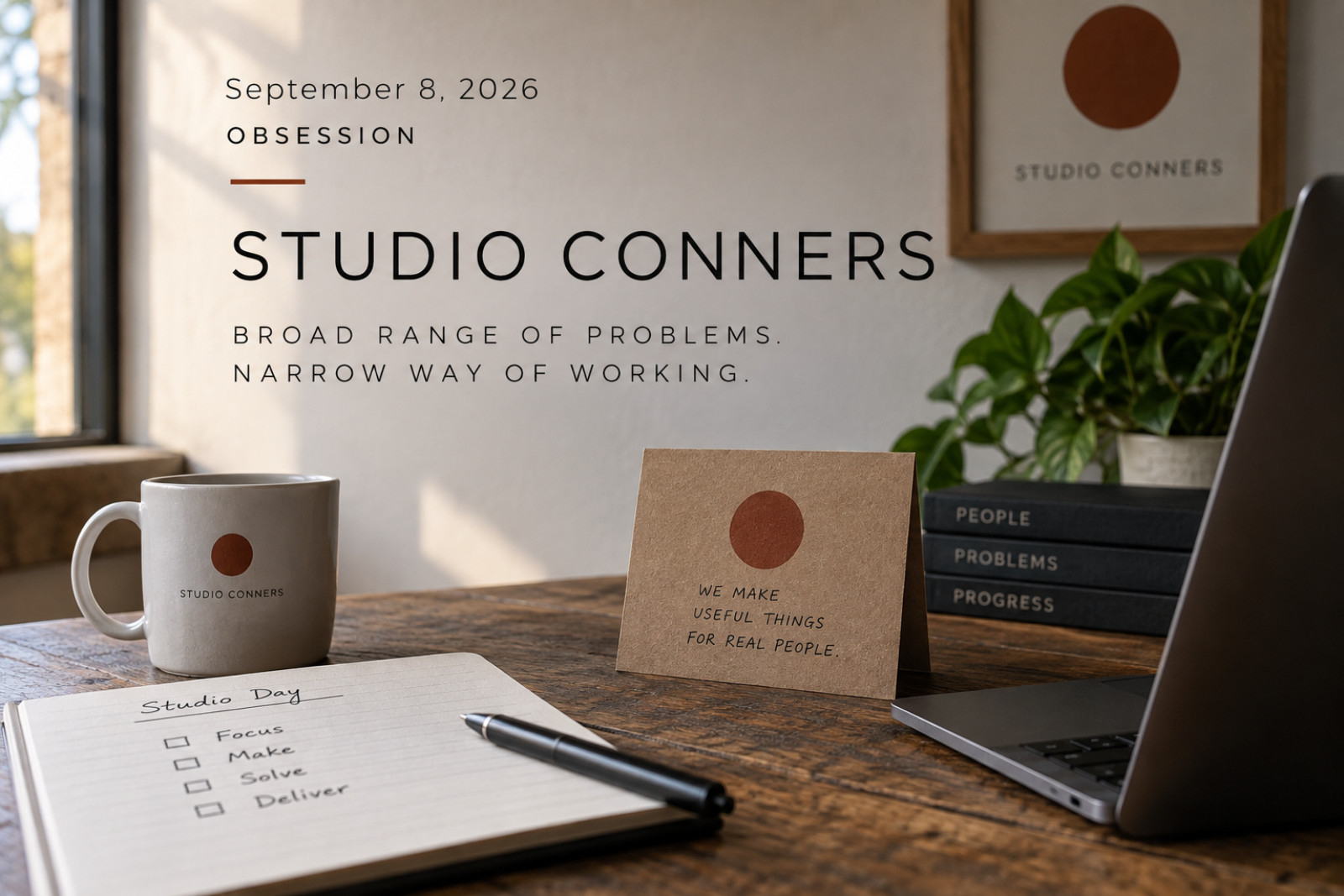
September 8, 2026
First Contact
What must happen between Studio Conners' first five contacts and its first paid Studio Day?
What came of the day
Studio Conners ended the day with a much clearer operating model for what a Studio Day is and how the business should work. We defined Studio Days as remote-first, focused one-day engagements: the client has our attention throughout the day and stays available remotely when we need questions answered, files, decisions, feedback, or other input to keep producing. Studio Conners will not invite clients to the home, and the business will not be built around onsite work. That led us to narrow away from services such as onsite photography and physical tech support while keeping the range of problems we can tackle intentionally broad: **“Broad range of problems. Narrow way of working.”** We also changed the first-contact model. Outreach will move from hand delivery to mail, with a PO Box assumed for public-facing business mail. We defined two ways a Studio Day can begin: an **invited Studio Day**, where Studio Conners identifies and clears a particular problem for someone to bring us, and a **public Studio Day request**, where someone approaches us with a problem of their own. An invitation clears the specific problem, not the person generally. The website now has a larger long-term role: it should eventually support nearly the entire Studio Day lifecycle, from invitation or request through preparation, the working day, and the final handoff/debrief. Finally, the returned family role forms clarified the real operating team. Shawn is the only **Core Member**. Kristin, Charlie, Henry, and George are **Project Contributors**, and John is a **Family Supporter**. Studio Conners therefore needs to function completely with Shawn as its only guaranteed operator. Family participation can expand what a Studio Day is capable of, but it cannot be load-bearing for the business.
The story
We began the day trying to make Studio Conners ready for actual first contact. The five initial outreach pieces were close to going out, but before sending them, we needed to be certain that the Studio Day we were offering made sense operationally—not just as marketing copy. That led us into a much deeper examination of what it means to give someone “our attention for a day.” We noticed that some of the existing language could leave a client wondering whether they were supposed to participate in person or whether Studio Conners might come to them. We clarified that neither is the model. A Studio Day is remote-first: Studio Conners goes into its own workspace and spends the day focused on the client’s problem, while the client remains reachable by phone, text, email, or computer when questions, files, decisions, feedback, or course corrections are needed. The client does not need to spend the day with us, but we need enough access to them to keep producing without unnecessary stalls. Once that became clear, several other pieces fell into place. Clients should not visit the Conners home, and Studio Conners should not depend on traveling to client locations. The planned hand-delivery of outreach no longer fit the business we were defining, so outreach moved to mail, with a PO Box assumed as the appropriate public mailing address. We also narrowed away from work that inherently requires us to be onsite, such as photography or hands-on physical tech support. Importantly, narrowing the way Studio Conners works did not mean narrowing the kinds of problems it can take on. Instead, we found a clearer expression of the business: **“Broad range of problems. Narrow way of working.”** Studio Conners can remain unusually flexible about the problems brought into the studio because every engagement passes through the same focused, remote, one-day operating structure. From there, we began treating the Studio Day as a complete lifecycle rather than simply a block of billable work. We defined two ways into that lifecycle. Studio Conners can invite someone to bring us a particular problem we have already identified, or someone can publicly request a Studio Day for a problem of their own. We clarified that an invitation clears the specific problem, not the person forever. This also changed how we think about studioconners.com: over time, the website should become the interface for nearly the entire lifecycle—from invitation or request, through preparation and the Studio Day itself, to the final handoff. We also examined what the client should receive at the end of the day. Because every Studio Day may produce very different work, the deliverables themselves cannot be completely standardized. But the handoff can be. The client should receive the things we actually made along with a consistent Studio Day debrief that explains what happened, what was produced, what we learned or concluded, and what may remain open. The internal ObsessOS closeout is related to that thinking, but the client-facing debrief needs to be its own intentional Studio Conners artifact. Late in the work, the family role forms gave us another important piece of reality. Shawn was the only person who chose the Core Member role. Kristin, Charlie, Henry, and George chose Project Contributor, while John chose Family Supporter. Rather than treating this as a weakness, we used it to correct the operating assumptions of the business. Studio Conners must be designed so that Shawn alone can reliably operate it. Family members can join particular Studio Days when their abilities, interests, or availability make sense, but their participation cannot be required for the company to function. By the end of the day, Studio Conners felt less like a collection of possible creative services and much more like a coherent studio system. We had not narrowed what Studio Conners is capable of nearly as much as we had narrowed the rules by which it operates. The result was a business model with clearer boundaries, a more honest understanding of its team, a stronger definition of the Studio Day, and a much clearer path for turning the website into the infrastructure that eventually carries the whole experience.
Discoveries
Remote-first is a design constraint that makes Studio Conners stronger.
Avoiding client visits and onsite work is not merely about convenience or privacy. It gives Studio Conners a repeatable way of working that protects focus and allows the same operating model to apply to many different kinds of problems.
Studio Conners can be broad in what it solves because it is narrow in how it works.
This is the deeper meaning behind “Broad range of problems. Narrow way of working.” The business does not need a conventional service-category niche if the Studio Day itself provides the consistent structure.
A Studio Day depends on mutual availability, not physical proximity.
Giving a client our attention all day does not mean sitting together all day. Studio Conners can work independently while keeping the client reachable for questions, files, decisions, feedback, and course corrections whenever needed.
An invitation should validate a problem, not permanently qualify a person.
Being invited means Studio Conners has seen enough of a particular problem to say, essentially, yes, bring us this. It should not become blanket permission for that person to book arbitrary future Studio Days.
The outreach method communicates something about the eventual relationship.
Hand-delivering an invitation subtly suggests a local, in-person service business. Mailing it better matches the remote-first Studio Day model and begins establishing the correct boundary before a client ever contacts us.
Studio Conners needs a deliberate boundary between the public business and the family home.
The PO Box, remote working model, and removal of home visits all point toward the same principle: Studio Conners can feel personal and local without making the Conners home part of the client-facing infrastructure.
The Studio Day is bigger than the hours spent producing.
The real product has a lifecycle: a problem is invited or requested, clarified and prepared, worked intensely for a day, and then handed back with a meaningful debrief and artifacts. That realization is why the website can eventually become much more than a marketing site.
Family participation cannot be assumed when designing the company.
The role forms revealed an important structural reality: Shawn is the only person who has committed to Studio Conners as a Core Member. Kristin, Charlie, Henry, and George may meaningfully expand what Studio Conners can accomplish, but the business has to remain viable when none of them participate in a particular Studio Day.
Optional contributors are potentially an advantage rather than a staffing problem.
Once Studio Conners stops treating family participation as required capacity, contributors can be brought into the particular Studio Days where their interests or abilities genuinely improve the work—without creating obligations the operating model depends on.
Results
Studio Day Operating Model Defined
Studio Days are now clearly remote-first, focused one-day engagements in which Studio Conners gives the client its attention for the day while the client remains reachable for questions, files, decisions, feedback, and course corrections.
Open the fileRemote-First Business Boundary Locked
Studio Conners will not host clients at the Conners home and will not build its core offer around onsite work. Photography, physical tech support, and other location-dependent services were moved outside the intended Studio Day model.
Studio Conners Working Principle Defined
We established the phrase “Broad range of problems. Narrow way of working.” as a concise expression of the Studio Day model: broad problem-solving capacity within a consistent remote, focused, one-day structure.
First-Contact / Outreach Model Revised
Initial outreach changed from hand delivery to mailed invitations, better aligning first contact with the remote-first business model. A PO Box was also assumed as the appropriate public mailing address.
Open the fileTwo Studio Day Entry Paths Defined
We established two ways a Studio Day can originate: Invited Studio Days, where Studio Conners identifies and clears a specific problem, and Public Studio Day Requests, where someone brings Studio Conners a problem of their own.
Open the fileInvitation Rules Defined
An invitation now explicitly clears a specific problem, not a person generally. Being invited once does not create blanket approval for unrelated future Studio Day requests.
Studio Day Lifecycle Architecture Defined
We established the longer-term direction for studioconners.com: the website should eventually support nearly the full Studio Day lifecycle, from invitation or request through preparation, the working day, and final delivery.
Studio Day Handoff Model Defined
We established that every Studio Day should end with both the actual work produced and a standardized client-facing debrief, even though the underlying deliverables will vary by problem.
Open the fileStudio Conners Team Roles Established
The completed family role forms produced a concrete team structure: Shawn as the sole Core Member; Kristin, Charlie, Henry, and George as Project Contributors; and John as a Family Supporter.
Open the fileSingle-Operator Baseline Established
The operating model was updated around the rule that Studio Conners must be fully functional with Shawn as its only guaranteed operator, with family participation treated as optional additional capability rather than required staffing.
Open threads
- Obtain a PO Box for Studio Conners and update public-facing business materials with the new mailing address.
- Convert the first five outreach packages from the hand-delivery plan to the final mailed format and send them.
- Audit studioconners.com for any remaining language that implies home visits, onsite work, or client participation in person, and bring it fully in line with the remote-first Studio Day model.
- Build the two Studio Day entry paths on studioconners.com: invited Studio Days and public Studio Day requests.
- Implement a way for an invitation to authorize one specific problem rather than granting general access to future Studio Days.
- Continue evolving studioconners.com into the operating interface for the full Studio Day lifecycle from intake and preparation through the working day and final handoff.
- Integrate the standardized Studio Day debrief into the actual client handoff workflow rather than leaving it as a standalone template.
- Define how Project Contributors are invited into individual Studio Days when useful without making their participation part of the business’s required operating capacity.